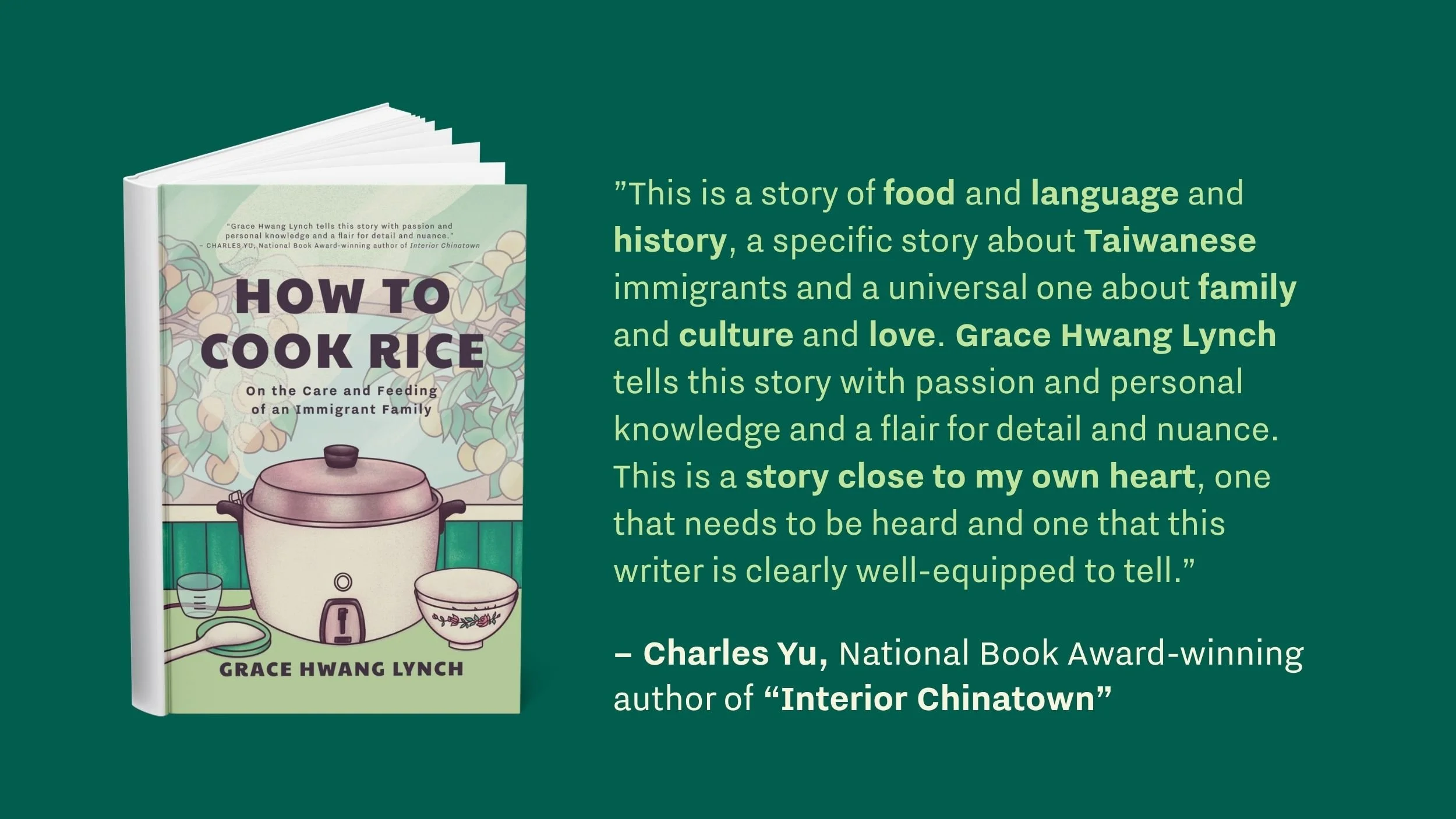
About How to Cook Rice
When I was a teenager, my mother would call from the car asking me to “tsú-pn̄g!” — or cook rice. With my parents’ separation and my mother’s return to work, suddenly I, as the eldest daughter, became responsible for the care and feeding of the family. In my suburban California Home Economics class, students learned how to make spaghetti and chocolate chip cookies, but they didn’t teach the skill I needed most: how to cook rice.
With much left unspoken in our family, I had to figure things out on my own—something that would continue into adulthood. After the birth to my first child, my mother brings over steaming pots of herbal soups, but doesn’t explain the complicated traditions around recovering from childbirth. And with my father, there is always some simmering tension about what foods are Taiwanese enough. How to Cook Rice: On the Care and Feeding of an Immigrant Family (Regalo Press, distributed by Simon & Schuster) is a food memoir comprised of 23 linked essays and 10 recipes that show how food says what words could not in a Taiwanese American family. Through these stories and included recipes, the meals Grace and her family eat express what words cannot, prompting an examination of what love—and food—mean in an immigrant family.
The book will be released on January 26, 2027, and I hope you will pre-order a copy today to support the publication of my debut book.

Cover illustration by Felicia Liang
Advance Praise for How to Cook Rice
This is a story of food and language and history, a specific story about Taiwanese immigrants and a universal one about family and culture and love. Grace Hwang Lynch tells this story with passion and personal knowledge and a flair for detail and nuance. This is a story close to my own heart, one that needs to be heard and one that this writer is clearly well-equipped to tell.
– Charles Yu, National Book Award-winning author of Interior Chinatown
In these essays, Grace Hwang Lynch beautifully braids together love, familial bonds, and food. With vibrant details, she captures something essential and true about the experiences of a second-generation Taiwanese American growing up in sun-kissed California, using food as metaphors that illuminate the histories of Taiwan and California.
– Shawna Yang Ryan, former Fulbright scholar and author of Water Ghosts and Green Island, (American Book Award winner)
Whether in Taiwanese Hokkien,‘chiáh-pá buē?’ or in Indonesian, ‘sudah makan belum,’ ‘have you eaten yet’ is both a greeting and a way to express concern for others. As an Asian woman, these words reflect the importance of food and culture as the very foundation of our identities. In her soulful collection of essays, Grace Hwang Lynch has underscored that to us, food is a love language, and expertly uses this leitmotif to highlight the struggle to express Asian love—both the giving and the receiving of it.
— Patricia Tanumihardja, author of Mortar and Pestle: Classic Indonesian Recipes for the Modern Kitchen
Grace Hwang Lynch writes with the taste buds of a gourmet and the storytelling smarts of a seasoned journalist, capturing the Gen X, NorCal Taiwanese American experience perfectly. Lee jeans? Ai yu jelly? Costco? Check, check, and check. I loved this memoir! Full of wry humor, smart insights, and mouthwatering descriptions, How to Cook Rice will make you very, very hungry.
– May-lee Chai, American Book Award-winning author of Useful Phrases for Immigrants and Hapa Girl: A Memoir, a Kiriyama Prize Notable Book
Grace Hwang Lynch’s How to Cook Rice is a wonderfully engaging narrative journey of a memoir, that defines and celebrates what it means to be Asian American and have rich cultural ties to our families’ homeland. She filters her journey through her passion for food and family, and as we learn about the differences between Taiwanese and Chinese cuisine, we also learn the tragic history of Taiwan and the experience of immigrants who settled in the U.S. This is a five-star, delicious read.
– Gil Asakawa, author of Tabemasho! Let’s Eat!: A Tasty History of Japanese Food in America
In Grace Hwang Lynch’s soulful memoir, the quest for xiaolongbao becomes a lesson in Taiwan’s political history; a rice cooker symbolizes the conflict between a mother’s duty and professional ambition; and an endless pot of long-simmering sauce is as a metaphor for inheritance and what’s passed from one generation to the next. In spare yet lyrical prose, Hwang Lynch explores what it means to be a daughter and a mother, and how the unique flavors and textures of Taiwanese cuisine are a language of their own communicating joy, hardship, transformation, persistence, and love.
— Grace Loh Prasad, author of The Translator’s Daughter
Grace Hwang Lynch’s How to Cook Rice is a delicious book you’ll want to slowly savor, but you’ll probably wolf it down in one sitting! Hwang Lynch writes with honesty, humor, and vulnerability to reveal what we are reluctant to express: that food is the way to our hearts when we cannot bring ourselves to confess, that motherhood is where we learn bravery and compassion, and that reckoning with family is how we heal and change.
— Stephanie Han, Swimming in Hong Kong